
China Diary (part 2 of 3)
Second Week: Tuesday (October 15)
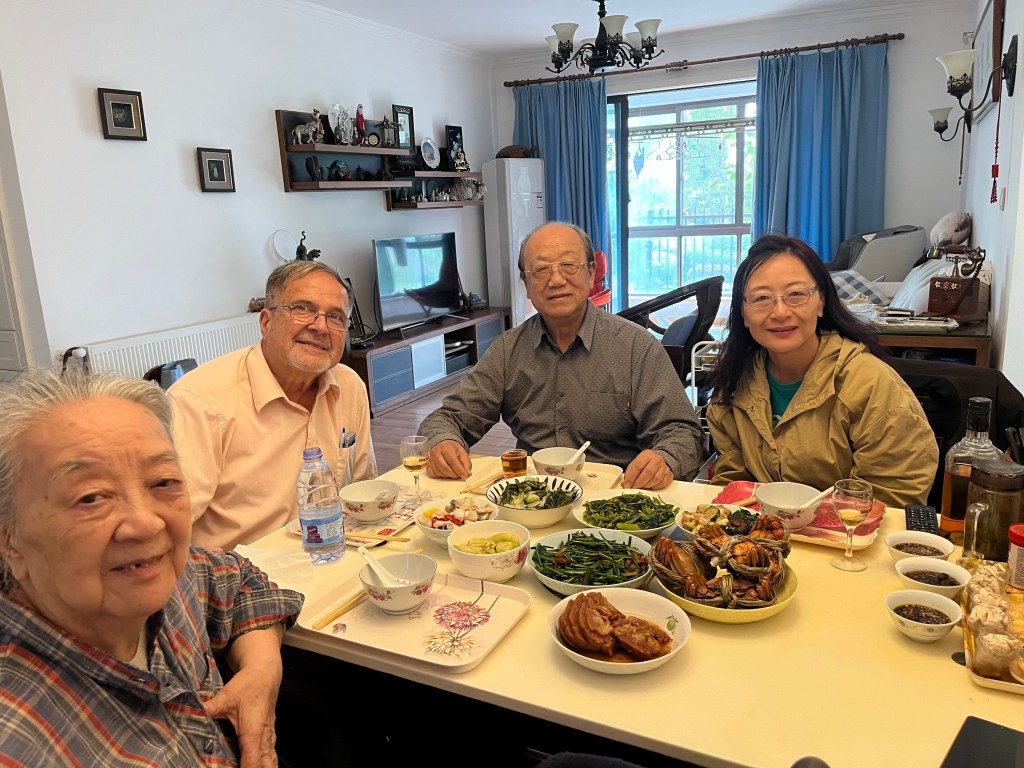
Had lunch at Jie’s parents today. I was curious about their memories of WWII. Jie was our translator. Both her mom and dad were born the year that Japan ransacked Nanjing–one of the most massive acts of violence in history. Her parents’ families had fled to small rural villages before the attack began. By the end of the war, Jie’s parents were around 8 years old–still living in the countryside. They said they were vaguely aware of the Japanese surrender–and not at all aware of the Tokyo war trial afterward. This was partly due to the remoteness of the village where they were staying, partly due to their young age, and partly due to the fact that WWII in China was immediately followed by civil war–between Mao and Chaing-kai-shek.
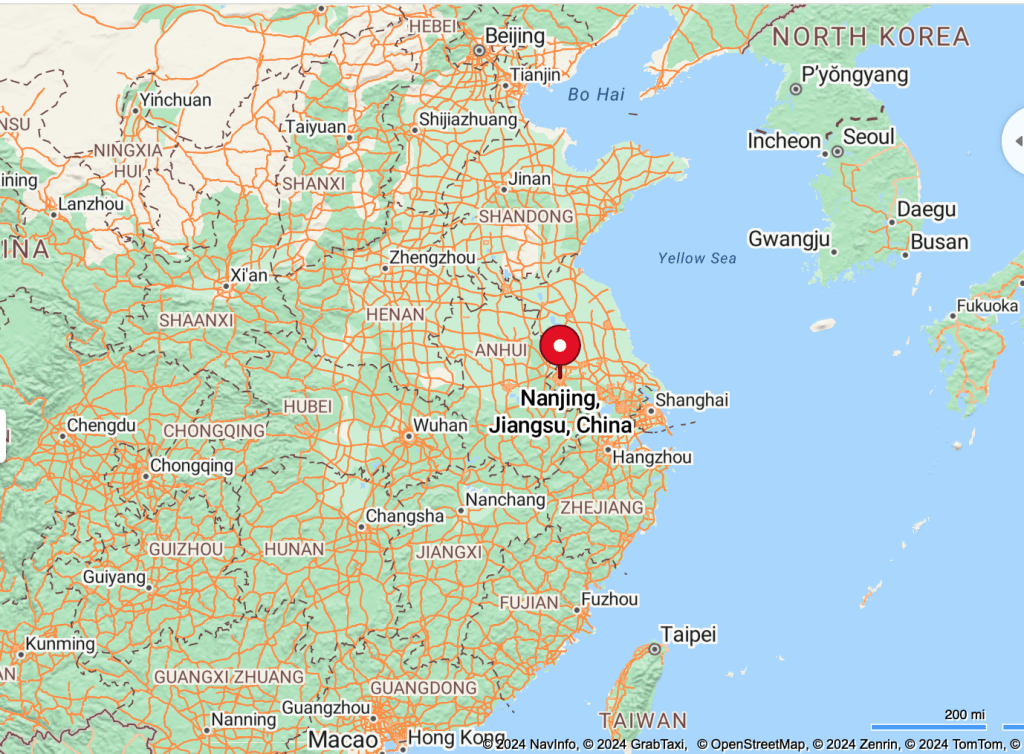
Jie and I spent the afternoon in the Jiangsu Province museum. China is divided into provinces (not states.) Nanjing (population 10 million) is the capital city of Jiangsu Province (population of 85 million.)
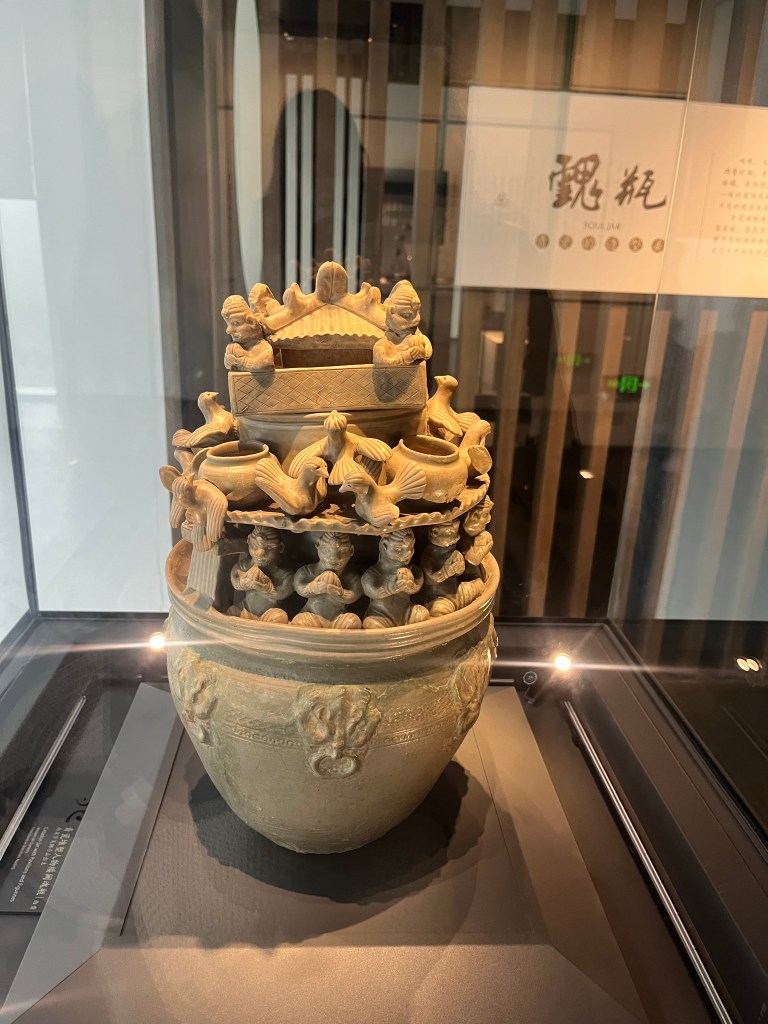
Since Jiangsu province is in one of the oldest human habitats in the world, their museum is filled with centuries of pottery, funeral artifacts, household items, and art.
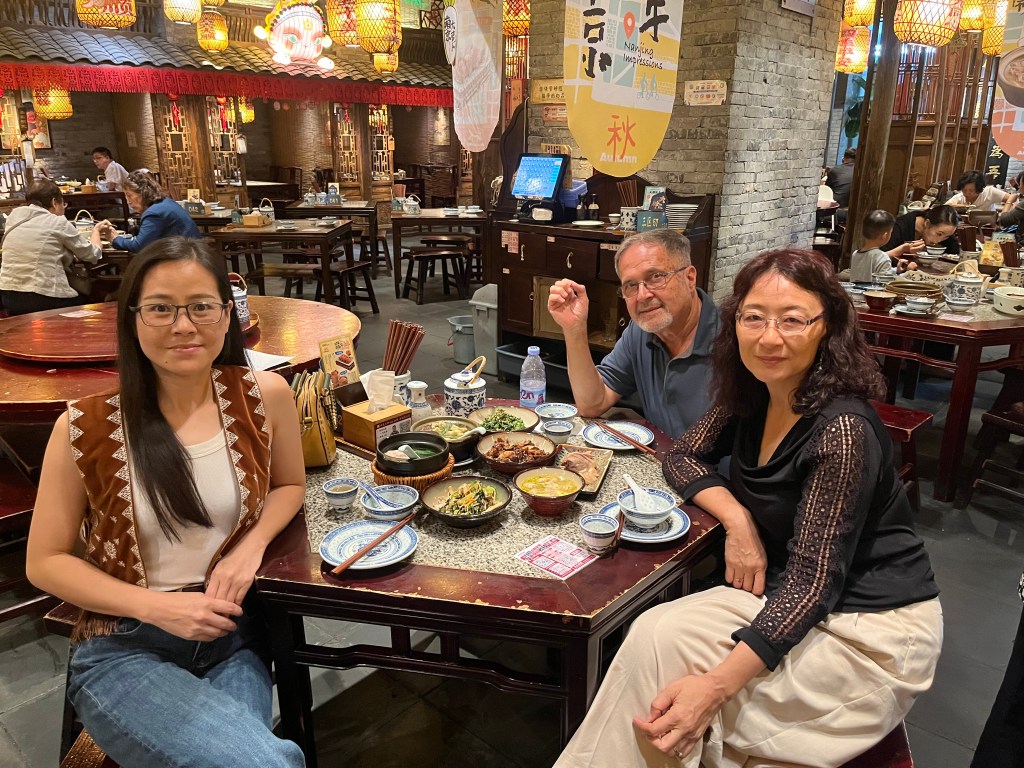
My sleep is better—now that I’ve been here a week—but I’m still feeling extra exhausted during the day. I’m ready to feel good for a change!
Second Week: Wednesday (October 16)
We spent most of the day with Yi Huang, a U of I visiting scholar, now back in China and teaching international commerce at Yiwu University. And a great friend.
The day was spent getting caught up on each others’ lives and strolling around Xuanwu Lake Park in Nanjing.

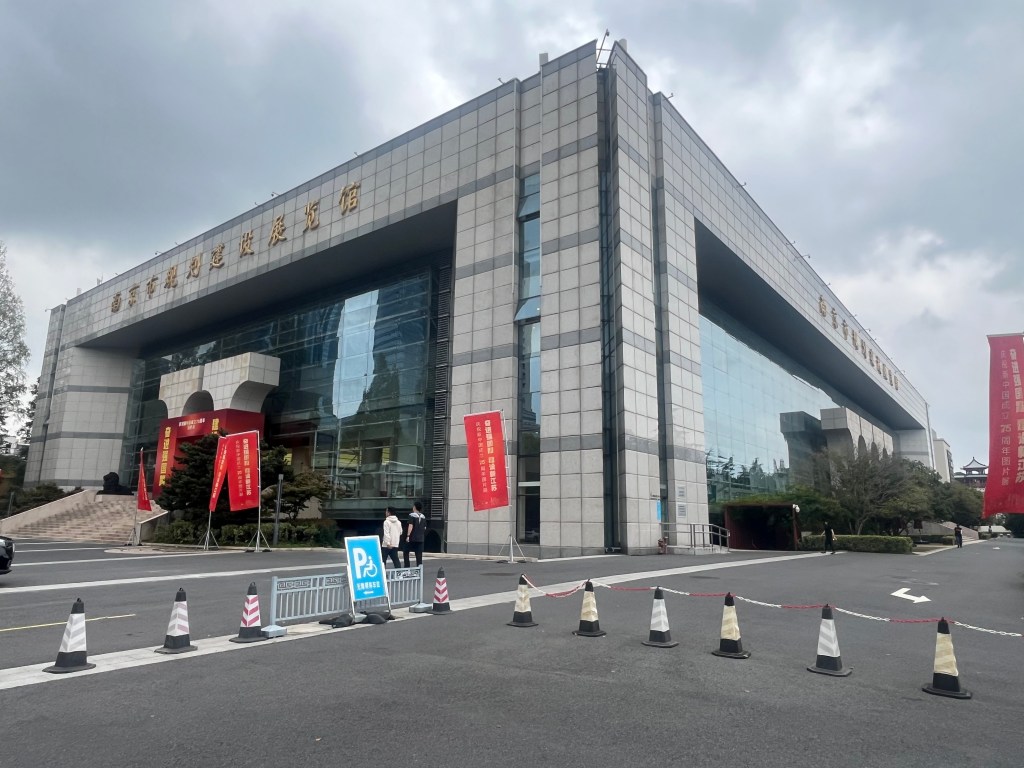
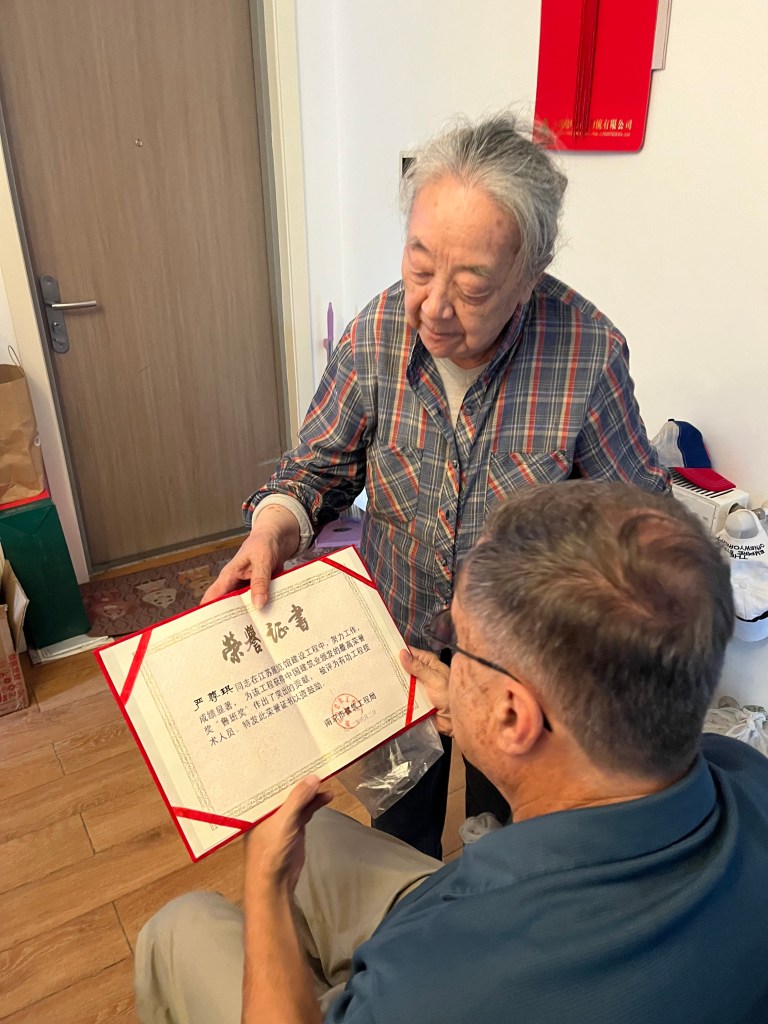
On the way to lunch, we passed by the Nanjing Convention Center, built in the 1990s. Jie’s mom was the chief engineer when it was built—the first woman in China to hold such a position. She received a First Place National Honor for her accomplishment. When we told her we had been by “her” building, she got out the award and showed it to us.
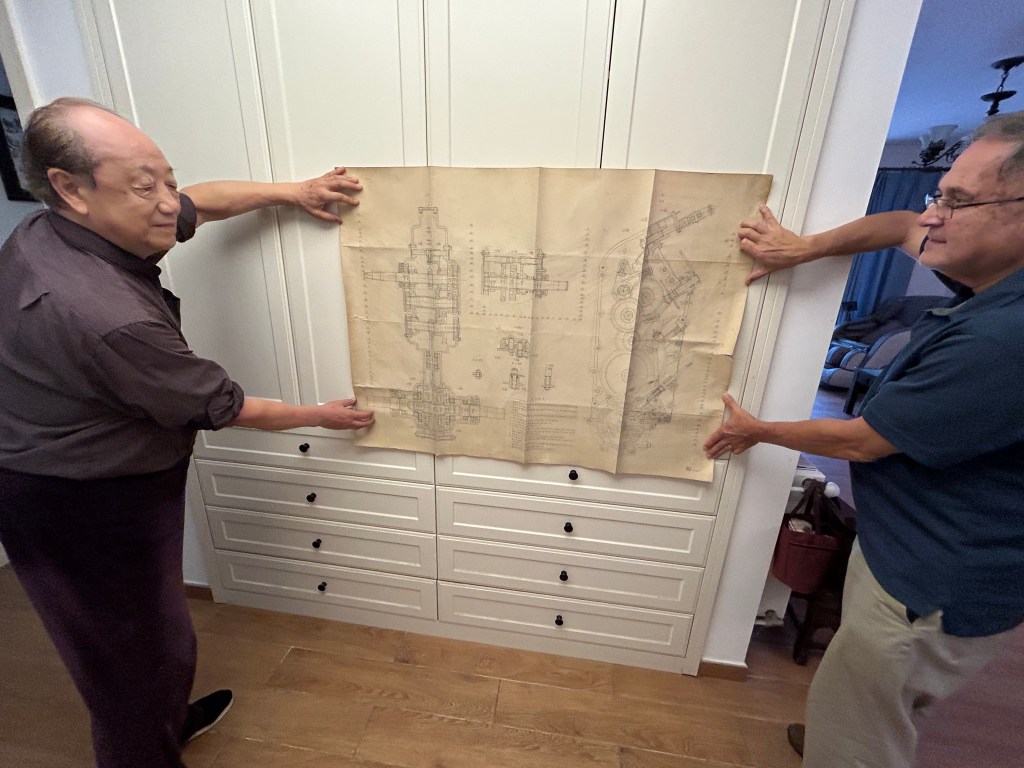
Not to be outdone, Jie’s father took out a drawing from his days as a mechanical engineer. He was the team leader of the first motorized tractor ever built in China—in 1965. The country had been importing motorized equipment from Russia prior to that. His team got hold of a Japanese tractor, took it apart, examined everything—then replaced certain parts with those that could be made in China. When they got it working, they took it around to different rural areas in China to see how functional it was—then modified it to meet regional needs. The drawing he showed me was the design his team made of that first tractor.
In the evening, we had another banquet—this time with four of Jie’s grade school friends. She had been telling them about me for years—but they weren’t sure if I actually existed, or was merely a figment of her imagination. It turned out I was recovered from jetlag enough so as not to embarrass her that evening. But her friends kept her embarrassed nevertheless—telling stories about her wild childhood.
Second Week: Thursday (October 17)
I seem to be finally over my exhaustion. Wouldn’t say I slept perfectly—but pretty good for an old man.
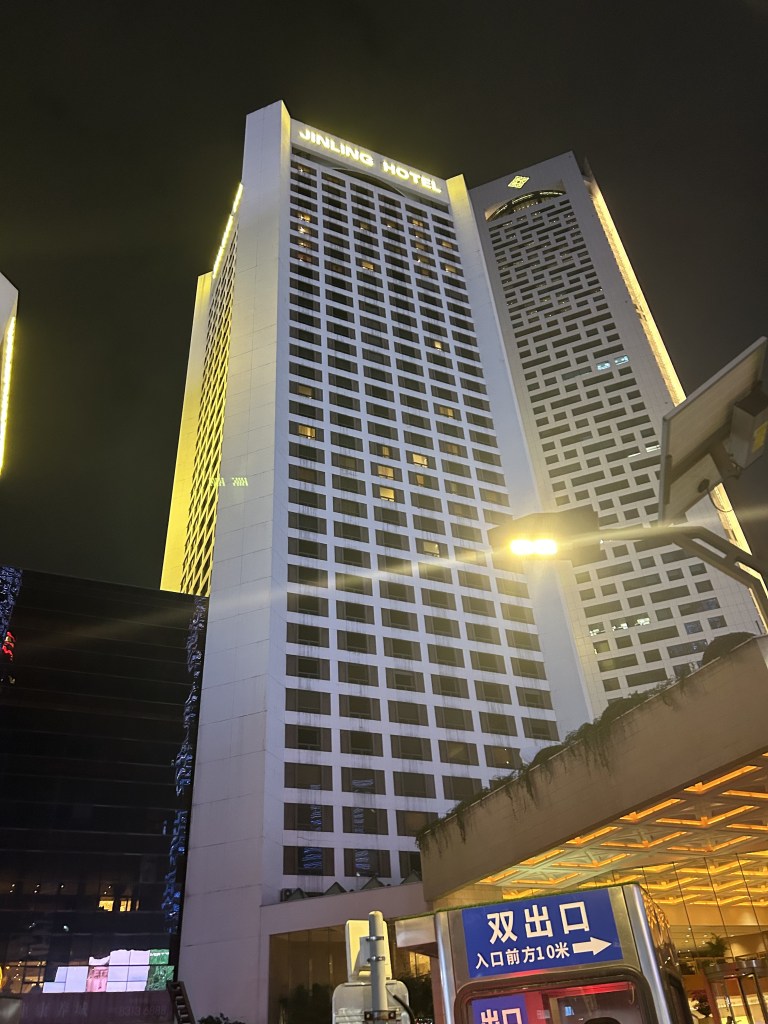
We spent the day seeing more sights in Nanjing—a Buddhist Shrine—then having dinner that night at the Jingling Hotel in downtown Nanjing. Jie’s grandfather was the chief engineer when the Jinling Hotel was built—between 1979 and 1983. At the time, it was the tallest building in China–and the first 5 star hotel built by the Chinese themselves.
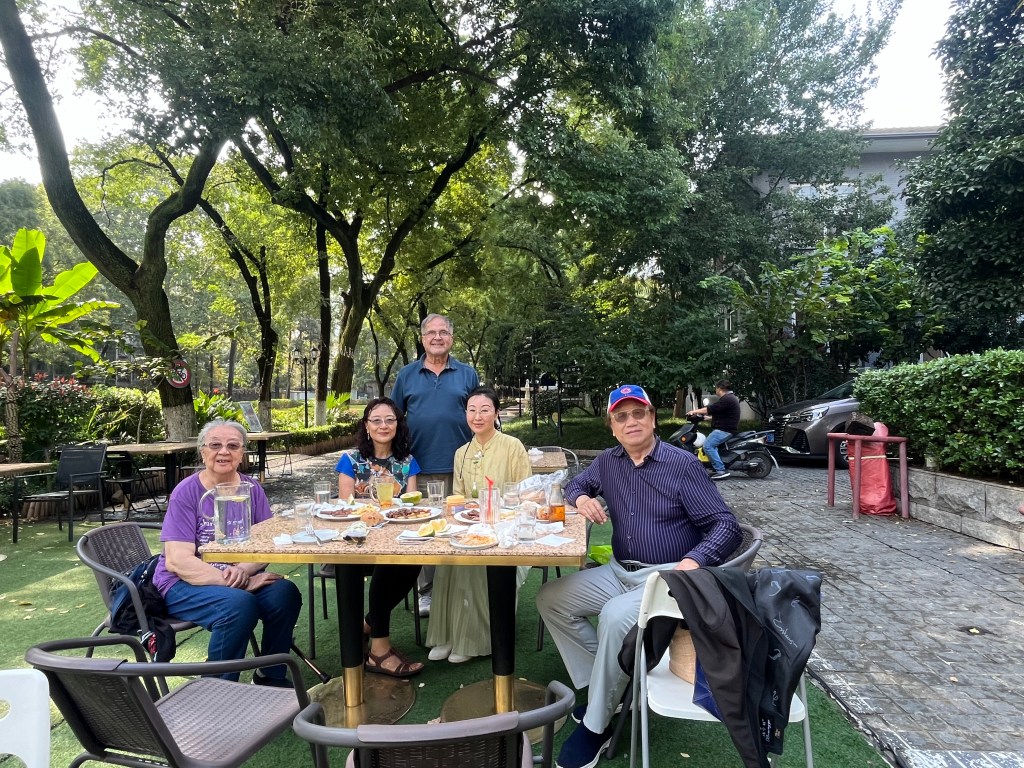
Dinner was with Jie’s college friend (another woman named Yi.)

The Buddhist shrine was beautiful—set atop a the Nui Mountain—and said to contain the bones of Gautama Buddha himself. Some people were offering prayers and incense—but the place reminded me of the tourist cathedrals of Europe—hard to sense the holiness with all the commercialism. Perhaps it is how Jesus felt when he cleansed the temple at Jerusalem.
Second Week: Friday October 18
This is our last day in Nanjing, and the last day I will see Jie’s parents. We met up with Jie’s sister (Jing) for lunch—and the whole family picnicked on hamburgers and french fries. (Word of advice: when in China, skip the American food. Don’t mean to offend anyone—but the imitations wouldn’t sell well here. On the other hand, the Chinese food there is so varied and excellent—that it would be a shame to spend even a single meal trying out something different. Jie’s sister is 8 years younger than her—and has a personality almost identical to Jie’s. Their parents just try to stay out of the way when the two of them get together.
Since Jie bragged that she and I play tennis regularly, Jing arranged a tennis court for us—and tennis rackets—and an audience of her and her parents. Perhaps I wasn’t over jetlag yet. Or perhaps the balls are different there. Or perhaps the borrowed tennis racket threw me off. But at least Jie wasn’t any better. We played so badly that Jie’s 87-year-old dad hobbled off his chair, walked out on the court, and took Jie’s racket to replace her. He and I volleyed a bit. Since I don’t speak Chinese—and he doesn’t speak English—we were unable to get into an argument over which of us won. So—we shook hands and both walked away with our pride intact.

That night I had my last meal with Jie’s parents. She would return there for another week after I went home. But it was my last time to be with them. And I felt very emotional. They are wonderful people, who have lived long, productive, difficult, and fulfilling lives. They have very little money, despite their accomplishments. But they talk of a sense of deep satisfaction—knowing what they have done to improve their country—and lives for others—even though they are little remembered by anyone these days outside our family.
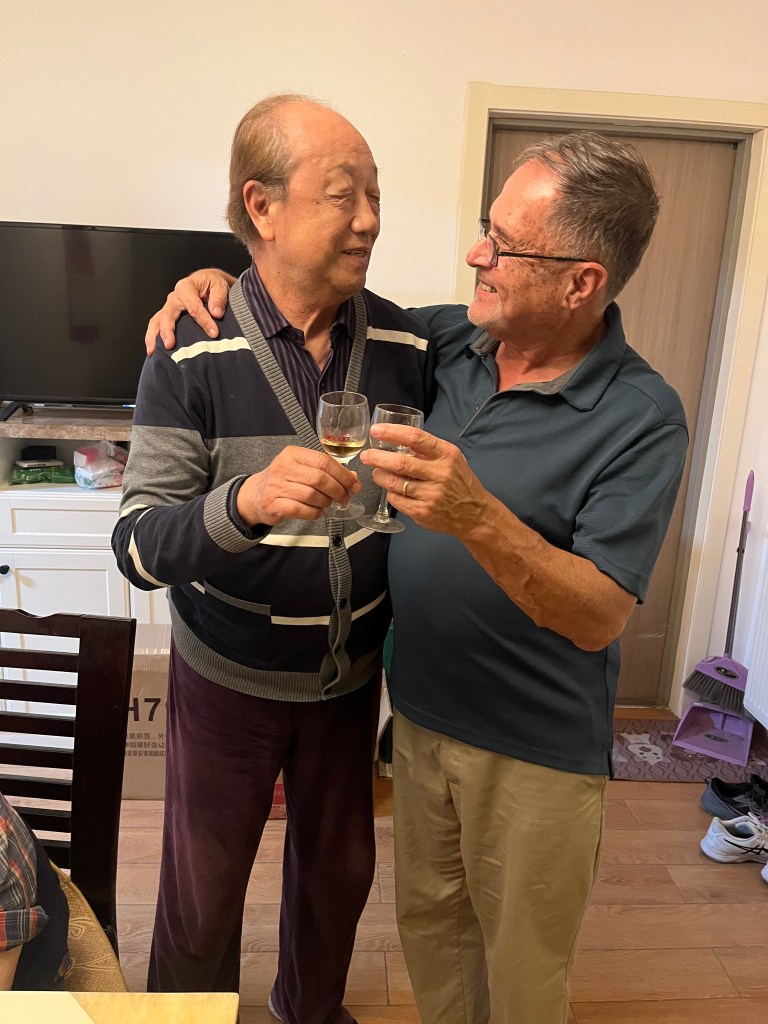
It is customary to bring gifts to one’s family when traveling to China. I got my mother-in-law a nice dishtowel with a map of Illinois–so she could see where all the family lived. For Jie’s dad, I got him a Cub hat as a gift—telling him the Cubs were one hat-wearing fan away from winning it all next year. And I brought him a U of I shot glass for his whiskey. And I brought him a large mug—for when he had a hard day and needed more than a shot. Even though I’m not a whiskey drinker, as I was getting ready to leave, I asked him if he and I could have a toast. It was a chance for me to express my love and appreciation for them both. In turn, they responded with their own words of affection and gratitude. Then we two men clicked our glasses—and I headed off to my hotel.
Second Week: Saturday October 19.
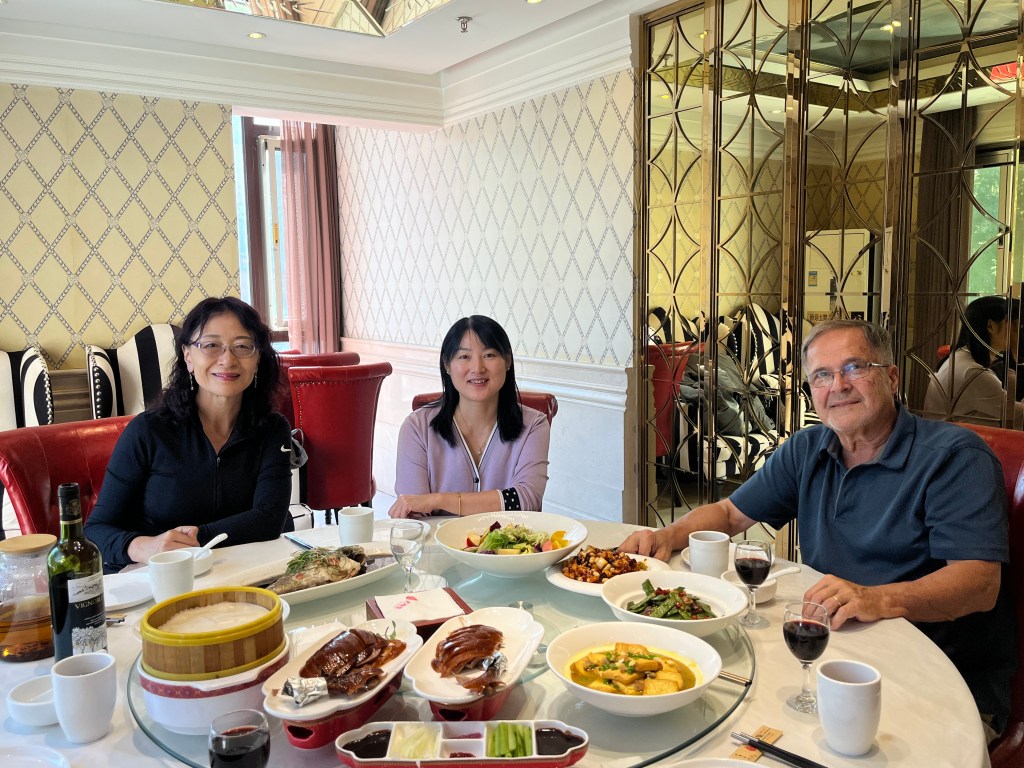
Got up early to catch the 9:30 high-speed train from Nanjing to Beijing. A 630 mile journey—only 3 hours by train these days. As soon as we got into Beijing, we were met by another Chinese scholar who was part of our international family at the U of I: Margaret. Margaret has advanced degrees in Library Science and specializes in services for students in Special Education. Included in the banquet she arranged for us was the traditional Beijing (Peking) Duck.
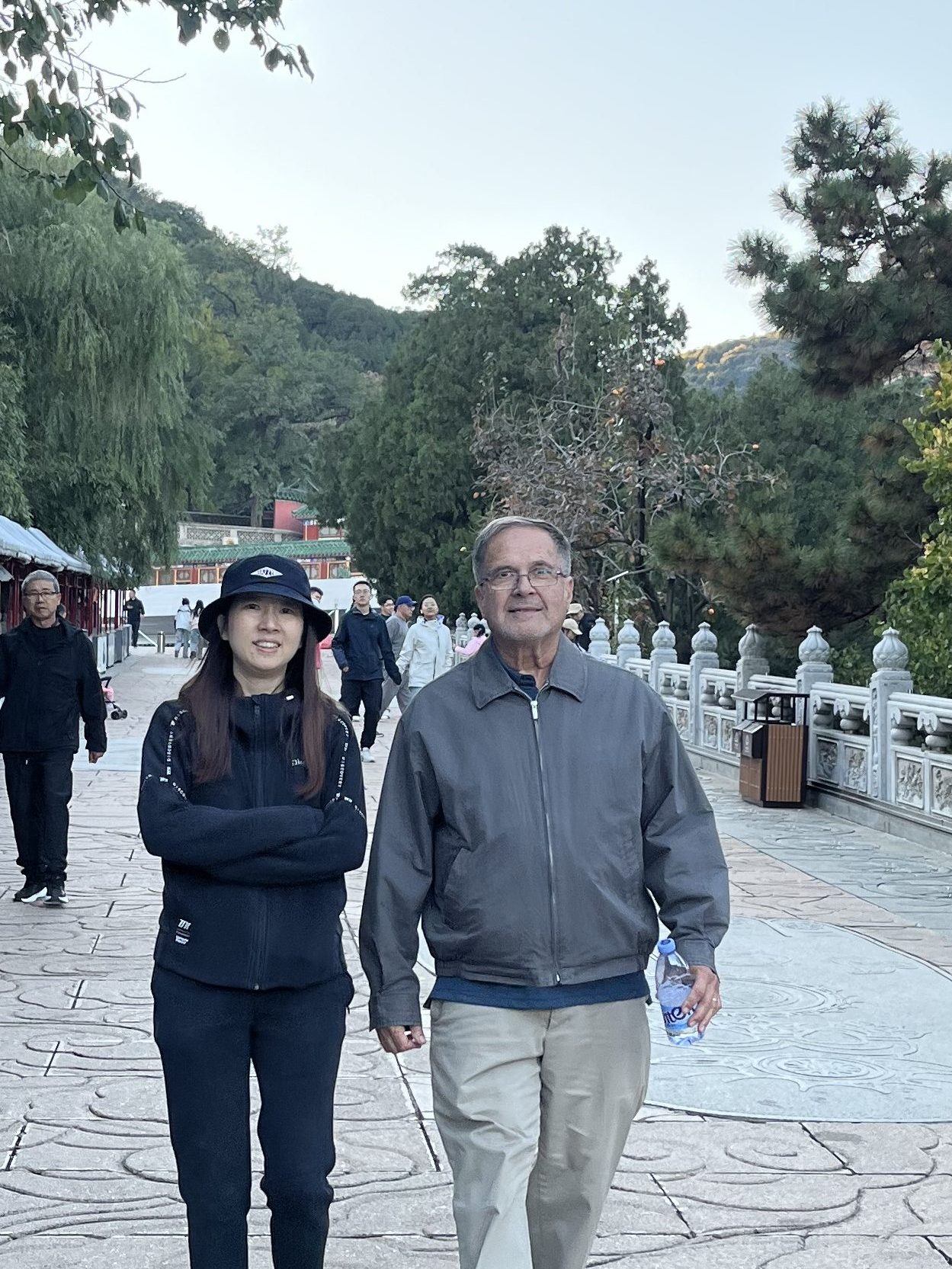
After catching up with Margaret, we were met by another great friend from a decade ago—Susu. Susu spent a year at the U of I while she was getting her doctorate in civil engineering. She went back to China and became a team leader for the building of Beijing’s largest (Daxing) airport—and a media spokesperson for the publicity when it opened in 2019. Susu is one of the most delightful and funny persons I have ever met. And we had a grand time remembering stories from her years with us in Urbana.
For dinner that evening, we were treated at another banquet—by Xinghua—an environmental scholar who was with us at the U of I—and now working to clean up coal fields in China. He and his wife and their spirited daughter hosted us. We talked about international politics, environmental issues–and renewed our friendship.
Second Week, Sunday October 20
On Sunday we got back together with Susu again—and were joined by Crystal—another great friend from a decade ago. Crystal is now teaching at a law school in Beijing. We all met up at the National Museum (across from Tiananmen Square.) When Crystal saw us, she burst out in tears—which worried me at first. But then she explained that it had been ten year ago—one of the happiest times of her life—and all those wonderful memories came flooding back when she saw us—and she just burst out. The National Museum in Beijing is one of the best in the world—giving a credible account of China’s history, natural resources, and economic and technological progress. While museums in the U.S. and Canada are often brutally honest when it comes to sharing the stories of their host governments, this is not the case in China. But the displays and narratives were valuable, nevertheless
After the museum—we were treated to another banquet by Susu, Crystal, and Junfei—another scholar who was part of our international community a decade ago. Afterward it was a dash to the train station for another high speed ride—this time to Xian—670 miles away—another 3 hour trip.
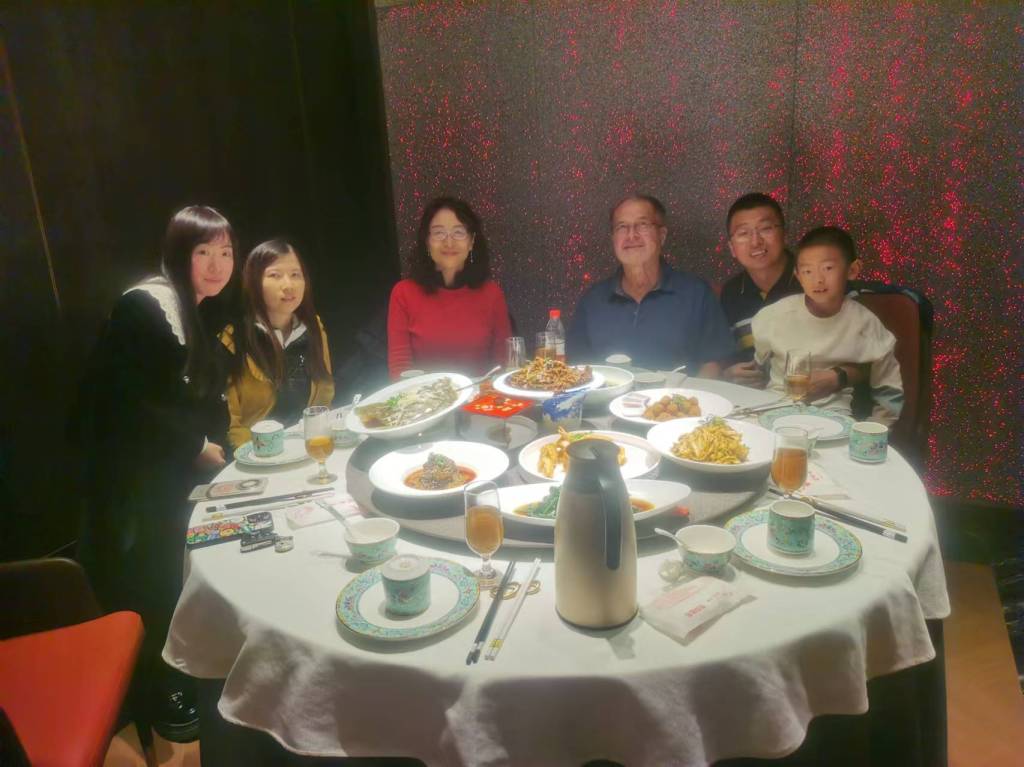
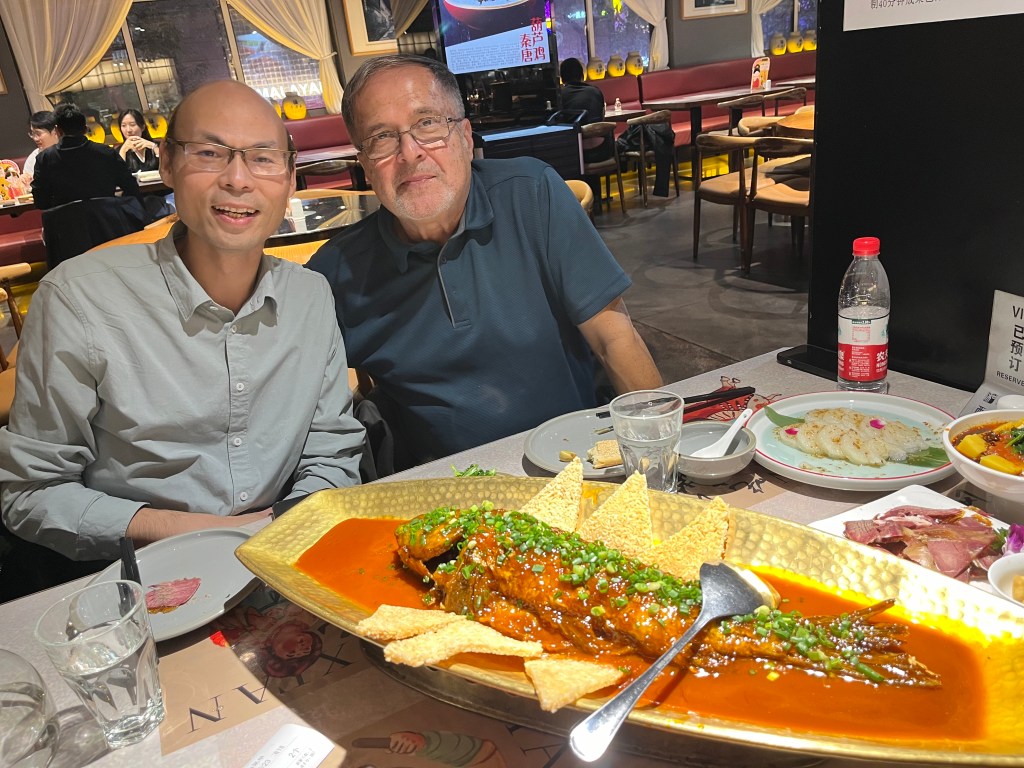
We arrived in Xian, China’s most ancient capital, at 9:00 p.m., where we were met by Jun Li—another professor—who was once part of our international community at the U of I. He took us out for another banquet. I was continually taken off guard by the enthusiasm of these young people who were energetically happy to see us and treat us to food and places of interest.
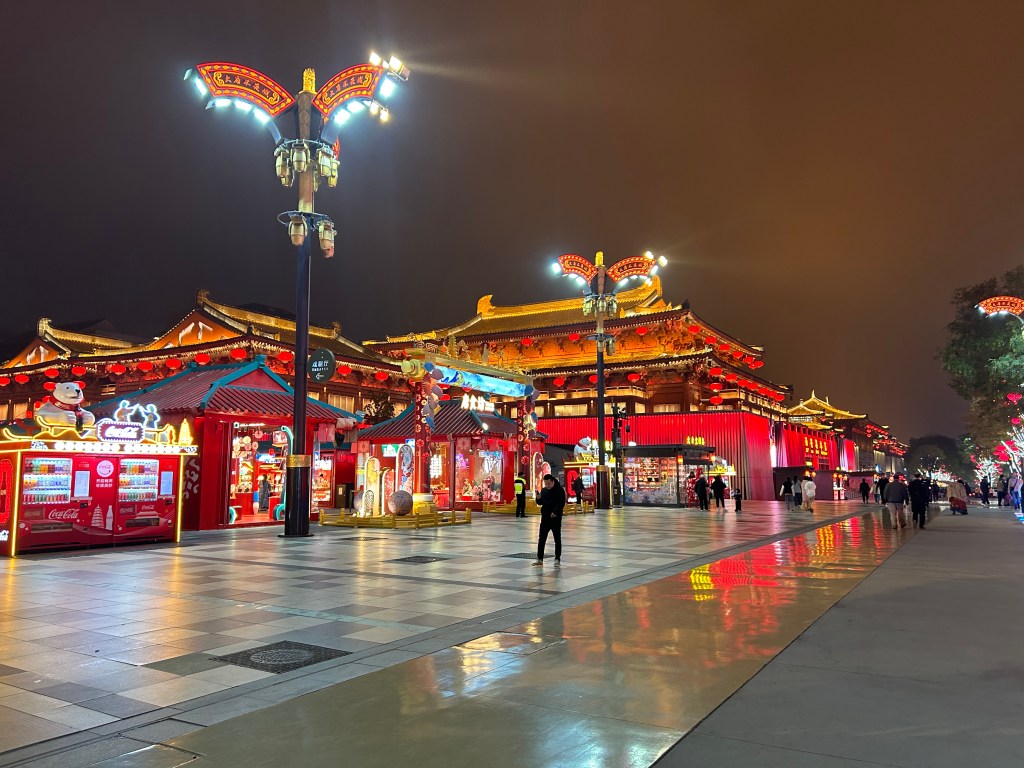
Jun Li took us on a late night tour of Xian—the city that never sleeps—that is lit with bright lights—to recall the climactic days of China’s ancient Tang dynasty. The color was incredible—photos only partially capture the grandeur of the sights.
Second Week: Monday, October 21
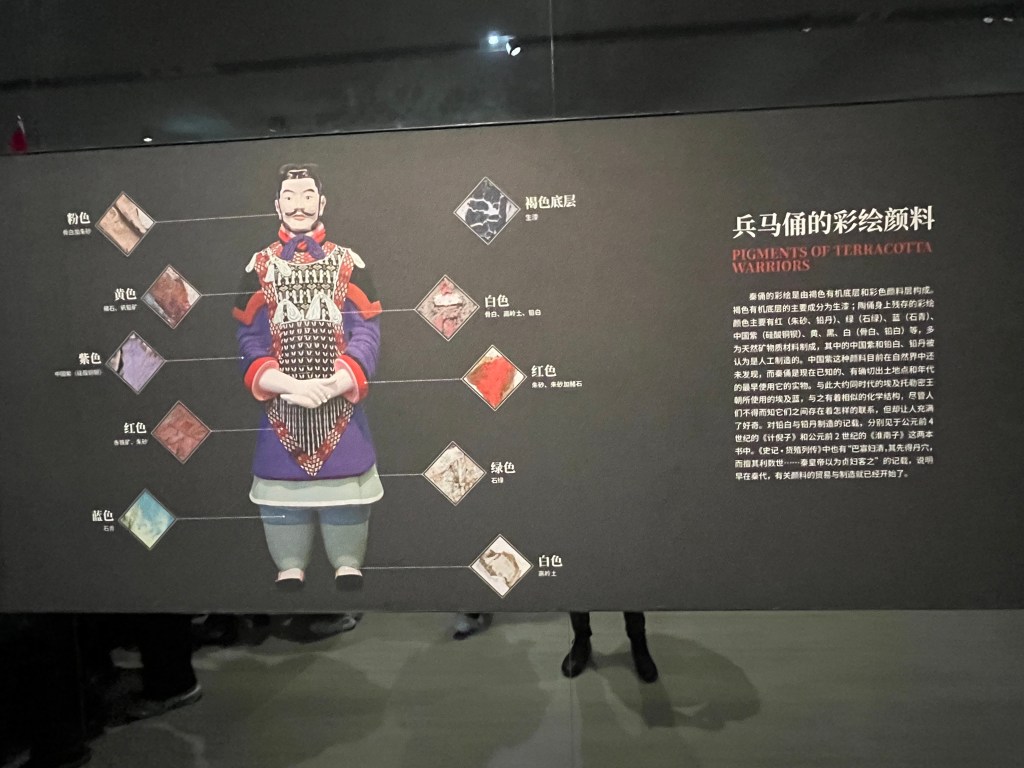
Today we went to see the Terra Cotta Warriors—perhaps the most amazing archaeological discovery ever. Two farmers were trying to dig a well 25 miles outside of Xian—in the 1970s, when they struck life-sized clay statues. They called the authorities—and scholars began to dig. A collection of 8000 life-sized, earthen soldiers were discovered. There was no historical record they even existed. A total surprise. The soldiers are all marching in columns. Each statue features perfect details in clothing and face. No two sculptured faces are alike–each one expressing a different emotion. When first uncovered, the figures were seen to be painted—but the paint faded immediately when exposed to fresh air. Huge buildings were constructed over the finds. A halt was called to the digging—to give time to invent ways to preserve the color for future digs. So, there are more to come–someday.
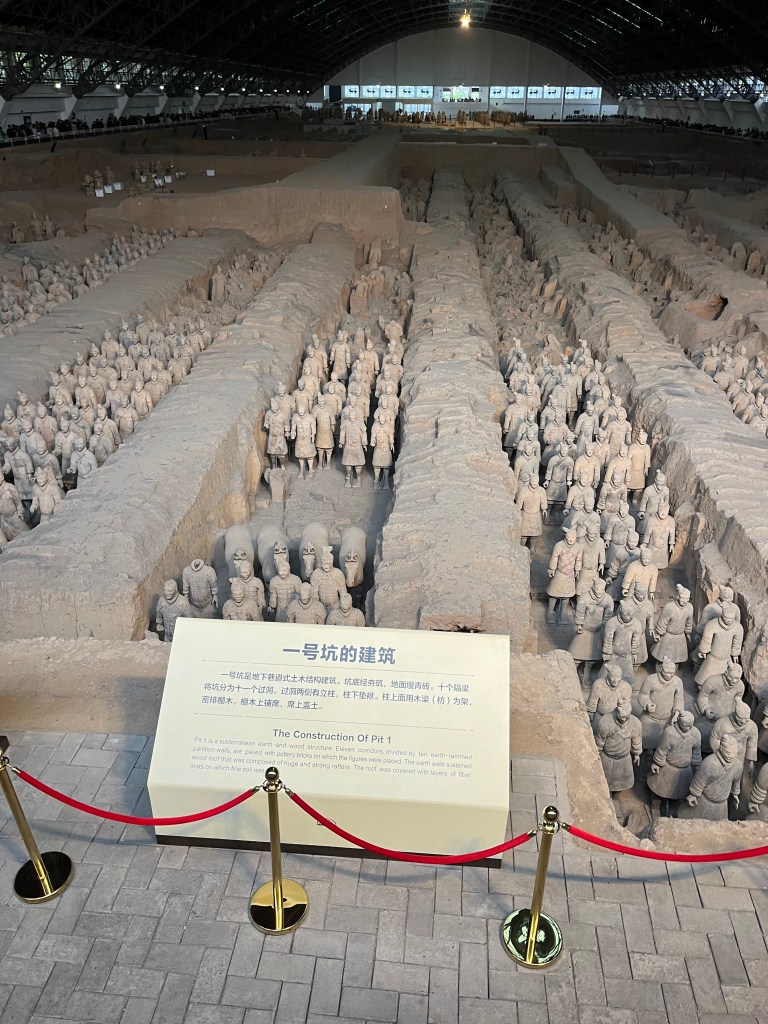
The statues were part of a burial rite for Qin Shi Huang, the first emperor of the Qin dynasty. They were buried near him in 209 B.C.
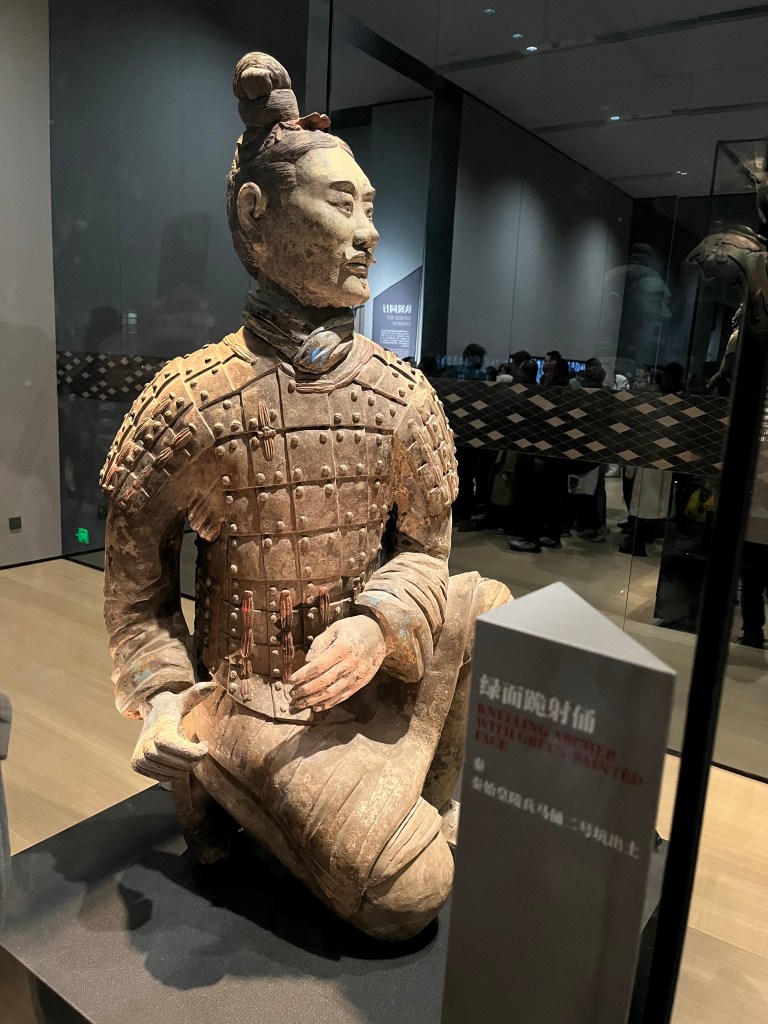
Seeing these pieces of art, I was both inspired and horrified. Inspired by the skill, discipline, and love that went into them. But also horrified at the Emperor Qin, his ruthlessness and violence, and his misrule—which brought an end to his dynasty, which collapsed less than three years after Qin’s death.
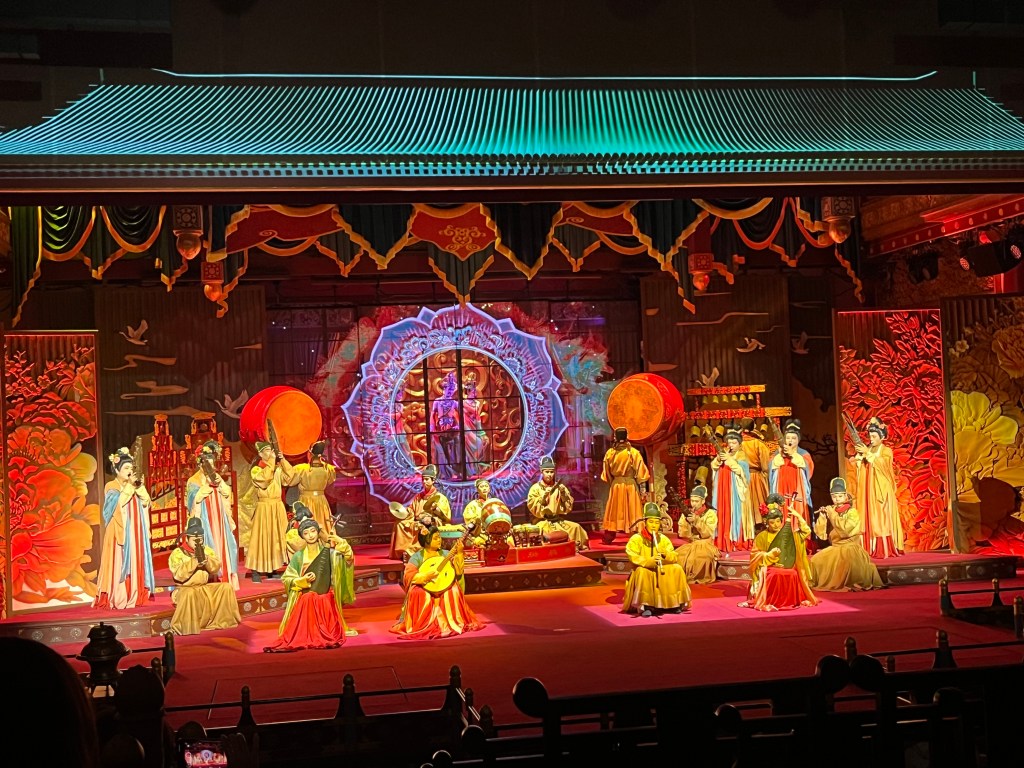
As if the day wasn’t exciting and fulfilling enough—we spent the evening at a park in downtown Xian and watched a musical—with songs, instruments, and dances from the early Middle Ages. When we got there, we realized that we had only paid for a cushion (on the floor, not one of the chairs. My cushion was quite uncomfortable—partly because the guy whose cushion was in front of mine was so close I had him trapped between my legs. Jie and I moved to the cushions in the back where there was more room. When the musical started, Jie decided to get up and sit in one of the empty chairs. About twenty people—also in the “cushion section” decided to join her. That was too much for the uniformed ushers—who chased them all back to the “economy” seats.
Afterward, we strolled through the beautiful park—along a lake, pavilions, and bright lights. Then we couldn’t find our way out of the park. We just kept going in circles. And every time we asked for directions, we would be sent back from where we had just come. Two pieces of good news: 1) we DID find our way out, eventually, and 2) I got 25,000 steps in that day.

Thus ends our second week on the China trip. Next–Part 3–including street food, mountain expeditions, and Guangzhou.
 Repertoire